What is WvW in Guild Wars 2 – Complete Guide
World vs World — known universally as WvW — is Guild Wars 2's large-scale Player vs Player mode, and for many players it represents the heart of the game. Three servers (or, in the Alliance era, three alliances) are locked together in a week-long campaign across four massive maps, fighting over castles, towers, supply camps, and vital chokepoints while accumulating points for their world.
Unlike instanced PvP modes, WvW takes place on persistent, open maps that any player can join at any time. You could be defending a wall with 50 teammates one minute and roaming solo the next. The scale, the permanence, and the community politics make WvW one of the most unique PvP experiences in any MMO.
The Four WvW Maps
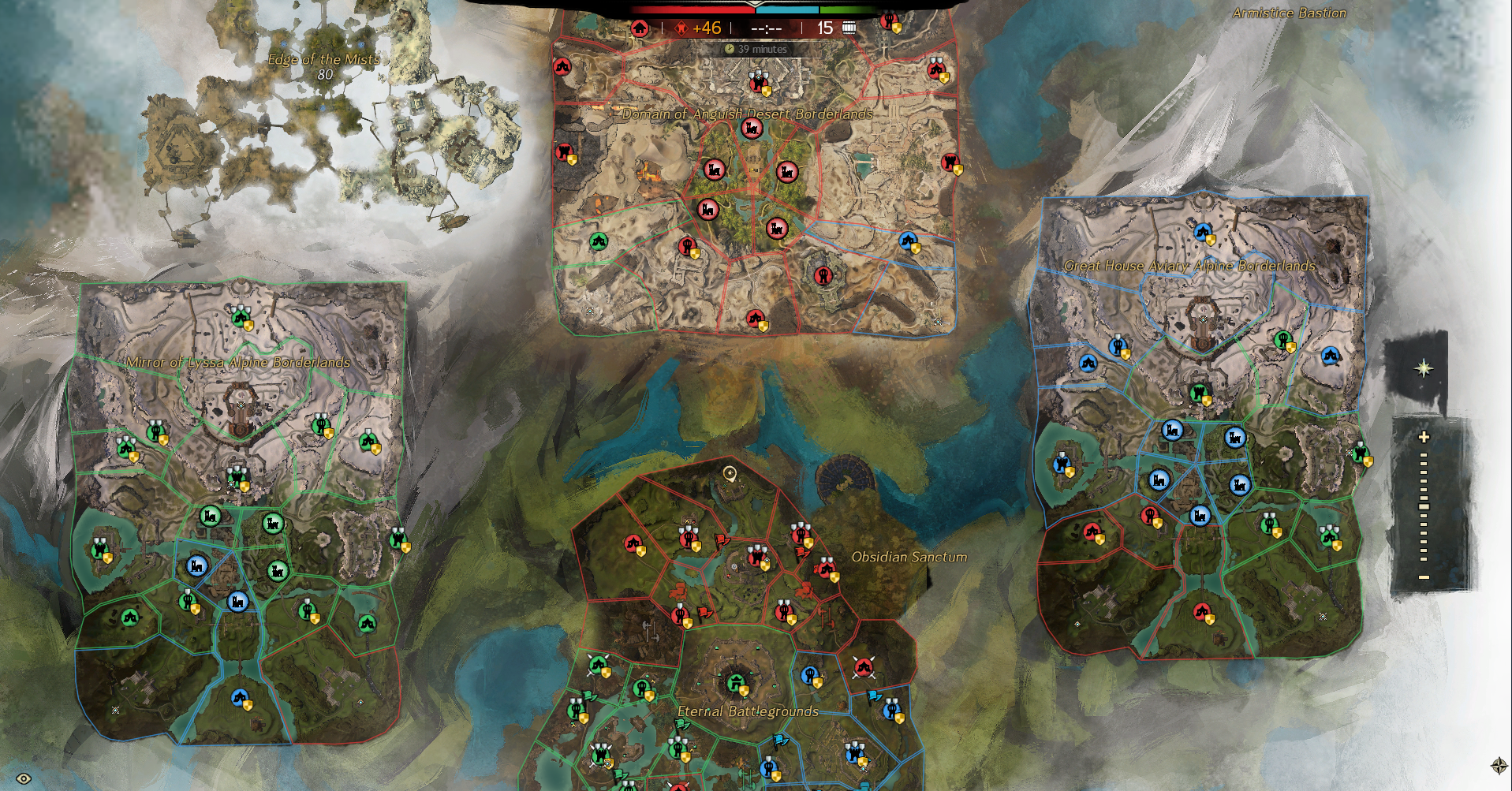
Every WvW match is fought across four distinct maps, each serving a different strategic purpose.
Eternal Battlegrounds (EBG)
The centrepiece of every WvW match. Eternal Battlegrounds is a large symmetrical map featuring the central castle, Stonemist, which is the most contested and prestigious objective in the game. Each of the three servers has a starting Keep in one corner of the map — Overlook, Valley, and Bay. Controlling EBG consistently is a strong indicator of a server's organised population.
The Three Borderlands
Each server also has its own Borderland map — Red, Blue, and Green — themed around one of the three playable factions in Guild Wars 2 lore. Borderlands are slightly smaller than EBG and feature a Home Keep (T3 fully upgraded by default), two additional Keeps, several Towers, Supply Camps, and a Citadel at the top of the map that rewards a powerful temporary buff when taken.
Objectives and How They Work
WvW objectives fall into four main categories, each contributing differently to your server's score.
Keeps
Keeps are the largest and most valuable defensive structures. They have multiple defensive layers — gates, inner gates, supply depots, guard NPCs, and siege weapon emplacements. Fully upgraded Tier 3 keeps provide significant points per tick. Taking an enemy keep requires either extended siegework or a quick strike exploiting a poorly defended moment.
Towers
Towers are smaller than Keeps but still require coordinated effort to capture. They serve as forward staging points and provide a modest PPT contribution. Many towers have a waypoint that, when upgraded, allows allied players to respawn and reinforce quickly — making their defence strategically valuable beyond the raw score.
Supply Camps
Supply Camps generate the supply that fuels everything else in WvW: siege weapon construction, gate repairs, and objective upgrades. Disrupting enemy supply lines by flipping their camps or killing their dolyak supply caravans is one of the most impactful low-player-count activities in the mode. A server running low on supply cannot repair walls or build catapults effectively.
Sentries, Ruins, and Shrines
These secondary objectives provide smaller benefits: a sentry reveals nearby enemies on the minimap, ruins in Eternal Battlegrounds provide a buff when controlled as a set, and Bloodlust shrines in Borderlands provide a stacking attack stat bonus. Controlling these may not win a match on its own, but they accumulate into meaningful advantages over the course of a skirmish.
Scoring: Points Per Tick (PPT)
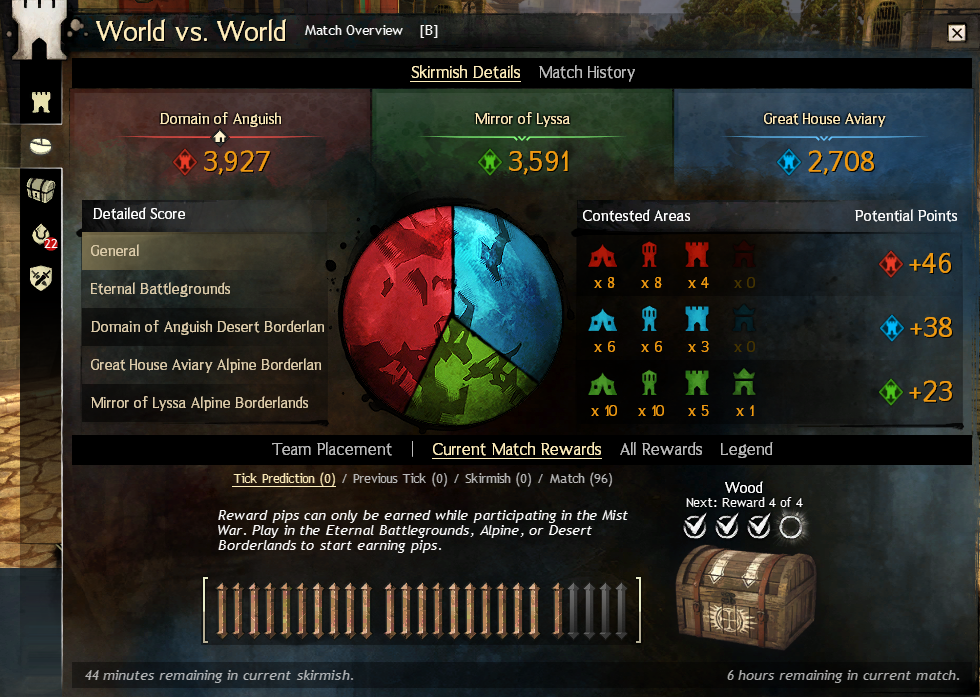
The WvW scoring system is based on Points Per Tick (PPT). Every few minutes, each server earns points based on the objectives it currently controls, weighted by their tier level. A fully upgraded Tier 3 Keep is worth far more per tick than a freshly captured Tier 1 tower. This means that holding fewer, high-quality objectives consistently outperforms flipping many low-value ones.
Matches are divided into skirmishes — roughly two-hour windows — and each skirmish has its own score tracked separately. The cumulative skirmish scores determine match placement at the end of the week, which determines whether your server rises or falls in WvW tier ranking (a system called Wood to Diamond tiers).
Rewards and Progression
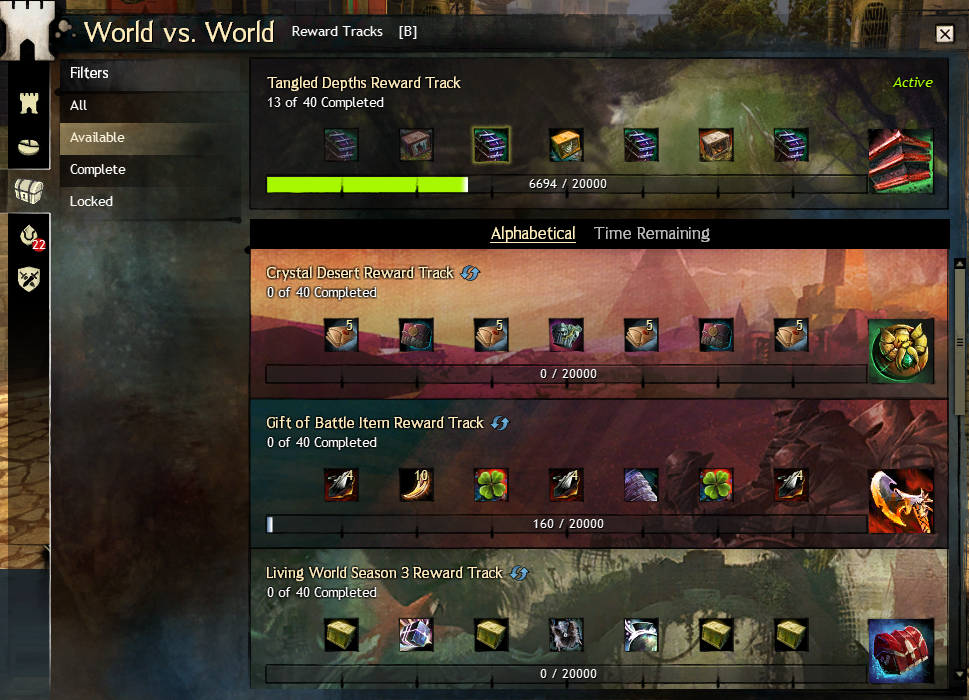
WvW has a rich reward ecosystem that keeps players engaged across hundreds of hours.
Skirmish Tickets and the Gift of Battle
Participating in WvW earns you Skirmish Tickets that can be exchanged for powerful WvW-exclusive weapons and the legendary precursor materials, including the Gift of Battle required for most legendary weapons. This alone makes WvW relevant to every player regardless of their interest in PvP.
WvW Rank and Abilities
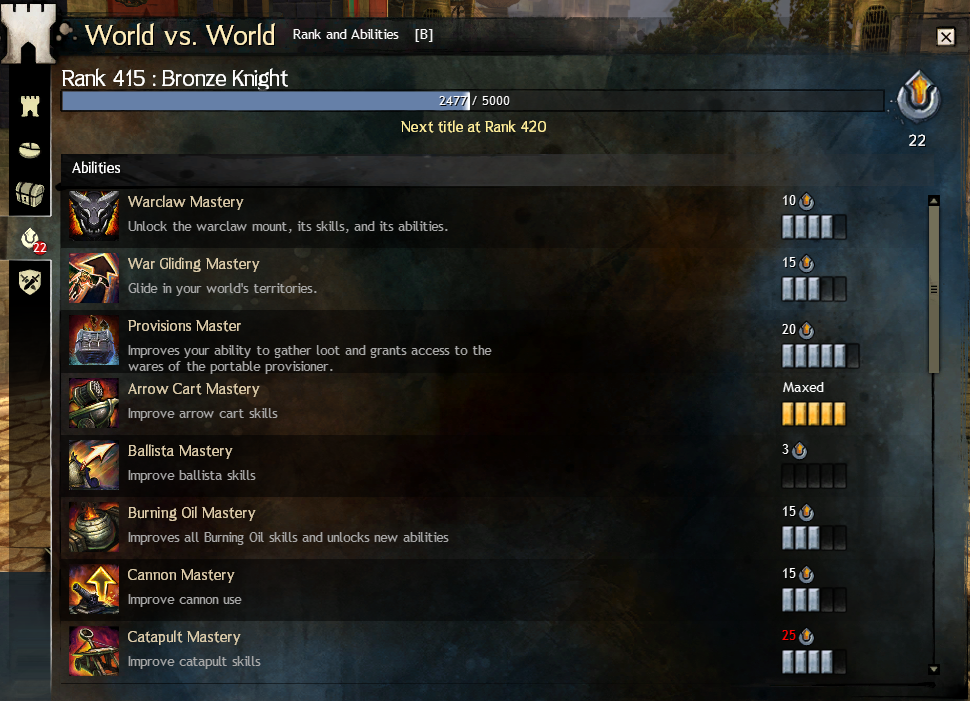
Your WvW Rank increases as you earn WvW experience. Higher ranks let you unlock WvW Abilities — passive bonuses that improve your supply carrying capacity, repair mastery, and defensive strength. These abilities make experienced WvW players noticeably more impactful than fresh entrants, rewarding long-term participation.
Legendary Armour and Weapons
The Conflux ring and the WvW-exclusive legendary backpiece are among the most sought-after cosmetic rewards in the game, requiring significant WvW participation over many weeks. For players who love WvW, these serve as a visible mark of dedication.
Getting Started in WvW
Accessing WvW is simple: press B to open the WvW panel, choose a map, and enter the queue. You are automatically bolstered to level 80 combat stats when you enter, so even brand-new characters can participate. That said, having unlocked traits, utilities, and a reasonably geared character makes a meaningful difference.
As a new player, the best starting advice is simple: follow a commander tag. The blue or yellow diamond icon above a commander's head marks them as a group leader. Trail along, watch what they attack and defend, and you will naturally absorb the fundamentals of large-scale WvW within a few sessions.
"WvW is not just a game mode — it is a community. The relationships you build in the Mists last longer than any individual match."
Using MistIntel to Enhance Your WvW Experience
One of the biggest challenges in WvW is information overload. Four maps, dozens of objectives, constantly shifting ownership, and limited minimap visibility make it very easy to miss critical events. This is exactly the problem that MistIntel was built to solve.
With MistIntel open in a browser tab, you can monitor all four maps simultaneously, receive instant browser notifications when important objectives flip, track commander movement, and view real-time score projections. For more detail on how to use it, read our guide on How to Track Objectives Efficiently in WvW.
Summary
- WvW is a week-long, three-server conflict across four persistent maps.
- Objectives — Keeps, Towers, and Supply Camps — generate points per tick.
- Supply is the logistical backbone; disrupting enemy supply is highly impactful.
- Skirmish scores accumulate into a match total that determines tier rank changes.
- WvW is one of the best sources of legendary crafting materials in the game.
- Following commanders is the fastest way to learn as a new player.
Track Every Objective in Real Time
MistIntel gives you a live view of every map, flip alert, and score projection — free, in your browser.
Open MistIntel →